A Cannot Fire Again After an Action Potential Passes Through a Section of the Axon
Key facts: activity potential and synapses
- Neurons communicate with each other via electrical events chosen 'activity potentials' and chemical neurotransmitters.
- At the junction betwixt two neurons (synapse), an action potential causes neuron A to release a chemic neurotransmitter.
- The neurotransmitter can either help (excite) or hinder (inhibit) neuron B from firing its own action potential.
- In an intact encephalon, the balance of hundreds of excitatory and inhibitory inputs to a neuron determines whether an action potential will result.
Neurons are essentially electric devices. At that place are many channels sitting in the prison cell membrane (the boundary between a cell's inside and outside) that allow positive or negative ions to flow into and out of the cell.
Commonly, the inside of the cell is more negative than the outside; neuroscientists say that the inside is around -70 mV with respect to the outside, or that the prison cell's restingmembrane potential is -70 mV.
This membrane potential isn't static. It'due south constantly going upwardly and down, depending mostly on the inputs coming from the axons of other neurons. Some inputs brand the neuron's membrane potential get more positive (or less negative, east.thou. from -70 mV to -65 mV), and others practise the opposite.
These are respectively termed excitatory and inhibitory inputs, every bit they promote or inhibit the generation ofactiveness potentials (the reason some inputs are excitatory and others inhibitory is that different types of neuron release unlike neurotransmitters; the neurotransmitter used by a neuron determines its effect).
Activeness potentials are the fundamental units of advice between neurons and occur when the sum total of all of the excitatory and inhibitory inputs makes the neuron's membrane potential attain around -50 mV (see diagram), a value called theaction potential threshold.
Neuroscientists frequently refer to activity potentials as 'spikes', or say a neuron has 'fired a fasten' or 'spiked'. The term is a reference to the shape of an action potential as recorded using sensitive electrical equipment.
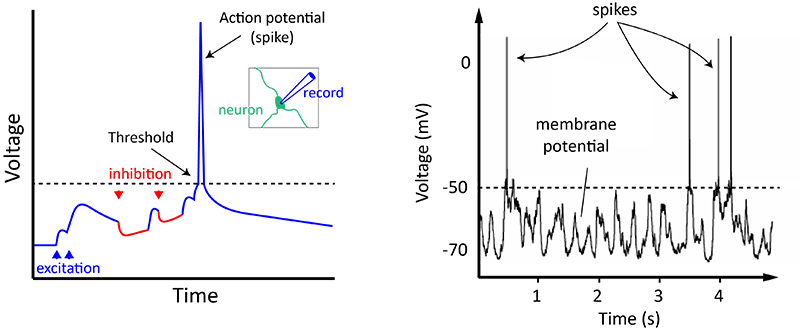
A neuron spikes when a combination of all the excitation and inhibition information technology receives makes it reach threshold. On the correct is an example from an actual neuron in the mouse'due south cortex. (Prototype: Alan Woodruff / QBI)
Synapses: how neurons communicate with each other
Neurons talk to each other beyondsynapses. When an action potential reaches the presynaptic terminal, information technology causes neurotransmitter to be released from the neuron into thesynaptic crevice, a xx–40nm gap between thepresynaptic axon last and thepostsynaptic dendrite (often a spine).
Subsequently travelling across the synaptic scissure, the transmitter volition attach to neurotransmitter receptors on the postsynaptic side, and depending on the neurotransmitter released (which is dependent on the type of neuron releasing it), particular positive (eastward.g. Na+, K+, Ca+) or negative ions (east.m. Cl-) volition travel through channels that span the membrane.
Synapses tin be thought of every bit converting an electrical bespeak (the action potential) into a chemical betoken in the form of neurotransmitter release, and then, upon bounden of the transmitter to the postsynaptic receptor, switching the signal dorsum again into an electrical class, as charged ions flow into or out of the postsynaptic neuron.
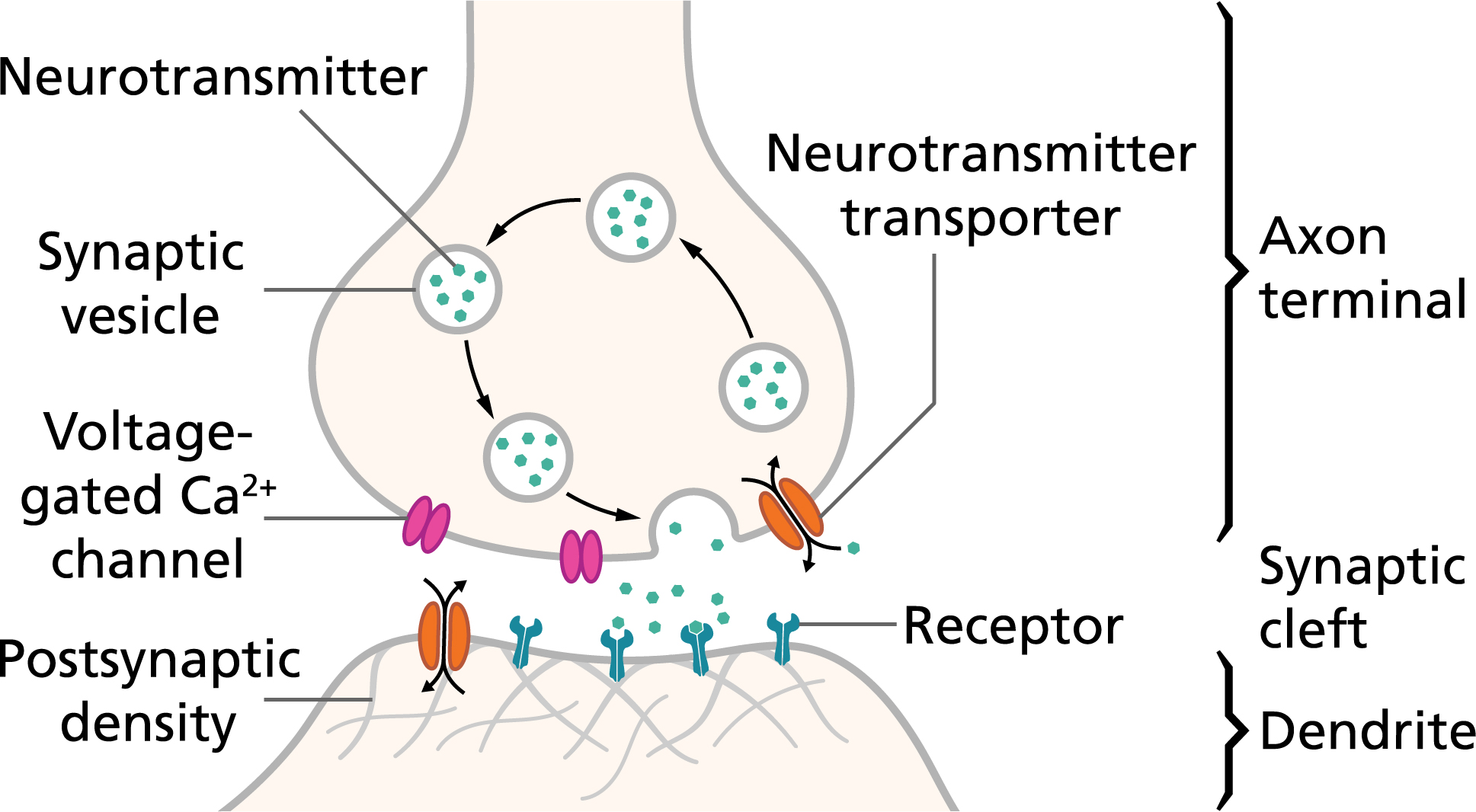
An action potential, or fasten, causes neurotransmitters to be released beyond the synaptic cleft, causing an electrical signal in the postsynaptic neuron. (Prototype: By Thomas Splettstoesser / CC Past-SA 4.0)
Video: Action potentials in neurons
Concepts and definitions
Axon – The long, thin structure in which action potentials are generated; the transmitting role of the neuron. Afterwards initiation, action potentials travel down axons to cause release of neurotransmitter.
Dendrite – The receiving part of the neuron. Dendrites receive synaptic inputs from axons, with the sum total of dendritic inputs determining whether the neuron will burn an action potential.
Spine – The small protrusions constitute on dendrites that are, for many synapses, the postsynaptic contact site.
Membrane potential – The electrical potential beyond the neuron'south cell membrane, which arises due to dissimilar distributions of positively and negatively charged ions within and outside of the prison cell. The value inside of the cell is ever stated relative to the outside: -70 mV means the inside is 70 mV more negative than the outside (which is given a value of 0 mV).
Activity potential– Brief (~ane ms) electrical event typically generated in the axon that signals the neuron every bit 'active'. An activity potential travels the length of the axon and causes release of neurotransmitter into the synapse. The action potential and consistent transmitter release permit the neuron to communicate with other neurons.
Neurotransmitter –A chemical released from a neuron following an action potential. The neurotransmitter travels beyond the synapse to excite or inhibit the target neuron. Different types of neurons use unlike neurotransmitters and therefore have unlike effects on their targets.
Synapse – The junction between the axon of one neuron and the dendrite of another, through which the ii neurons communicate.
QBI research
QBI Laboratories working on neurons and neuronal advice: Professor Stephen Williams, Professor Pankaj Sah
QBI Laboratories working on synapses: Dr Victor Anggono, Professor Joseph Lynch, Professor Frederic Meunier
Source: https://qbi.uq.edu.au/brain-basics/brain/brain-physiology/action-potentials-and-synapses
0 Response to "A Cannot Fire Again After an Action Potential Passes Through a Section of the Axon"
Post a Comment